The battle for talent within the EU is a story about both brain drain and gain. Of the 17 million people aged 15–64 migrating within the EU1, around 4.5 million are highly skilled workers and students. Factors known for attracting these people from their home regions are economic growth, higher wages, robust social security, linguistic and cultural similarity, relatively easier access to the labour market and higher employment rates.2
In contrast, the brain drain phenomenon arises when a region can not compete and suffers a permanent loss of skilled workers or students.
Outer London - East and North East is a “receiving” region, with more people moving in than out. In 2017 the net migration rate was 4.2 persons per 1,000 inhabitants.
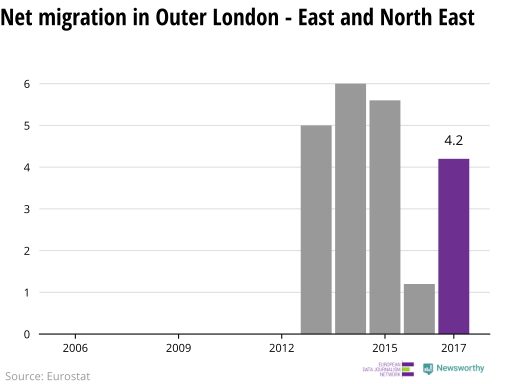
Receiving regions are generally found in northern areas of the EU, e.g Sweden, Ireland, Estonia, Denmark and the UK.

The battle for the brains
The nature of the migration flows differs considerably across Europe. Some regions attract and gain highly educated workers, while others lose them. In this section we look closer at the education level of the newcomers, compared to the domestic population. Do the migrants4 affect the supply of skilled labour?

These are some of the key findings for Outer London - East and North East:
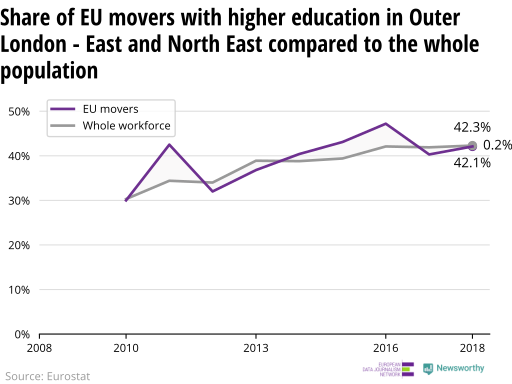
- Europeans that have moved to Outer London - East and North East have about the same education level as the workers born in The United Kingdom (42 percent of EU movers have higher education).
- This level makes Outer London - East and North East popular among highly educated migrants compared to other European regions. 5
| Region | Share of EU migrants that have higher education | |
|---|---|---|
| 1. | Inner London - West | 74% |
| 2. | Inner London - East | 63% |
| ⋮ | ||
| 22. | Outer London - East and North East | 42% |
| ⋮ | ||
| 39. | Leicestershire, Rutland and Northamptonshire | 25% |
| 40. | Lincolnshire | 20% |
Same employment as domestic workforce
In general, highly educated workers in the EU that have moved to another EU country find employment at more or less the same level as the domestic workforce.
In Outer London - East and North East the employment rate for highly educated newcomers is about the same for workers born in The United Kingdom (87 percent compared to 86 percent among all educated workers in Outer London - East and North East).
| Region | Employment level among highly educted EU workers | |
|---|---|---|
| 1. | Lancashire | 100% |
| 2. | Tees Valley and Durham | 97% |
| ⋮ | ||
| 26. | Outer London - East and North East | 87% |
| ⋮ | ||
| 39. | West Central Scotland | 76% |
| 40. | Southern Scotland | 75% |
What about the future? Reports on the modern knowledge economy say that high skilled immigration will continue to boost economic growth in the attractive regions. Income differentials combined with differences in living standards between regions will remain the primary driver of economic migration. The demand for skilled labour is robust. By 2025 nearly half of all new expected job openings in the EU is expected to target highly qualified workers6.